
Tactile response! Science by Lee Wilkin
We don’t normally have guest blogs but Lee Wilkin here has written something that really is interesting and I wanted to share:
Hi, I purchased a New Model M Unicomp keyboard from your company some time ago and wish to communicate my satisfaction with the product. I thought you might be interested in a short essay on this product:
The Determinant Interface: Superior Engineering for Cogent Expression
Human beings are distinctively tactile creatures living in an increasingly ethereal digital world. While modern design trends push toward the frictionless- touchscreens without texture, keyboards with shallow travel and interfaces that prioritise silence- there remains an argument for the friction of the physical; because a well-engineered tool does not merely receive input- it structures the mind of the user.
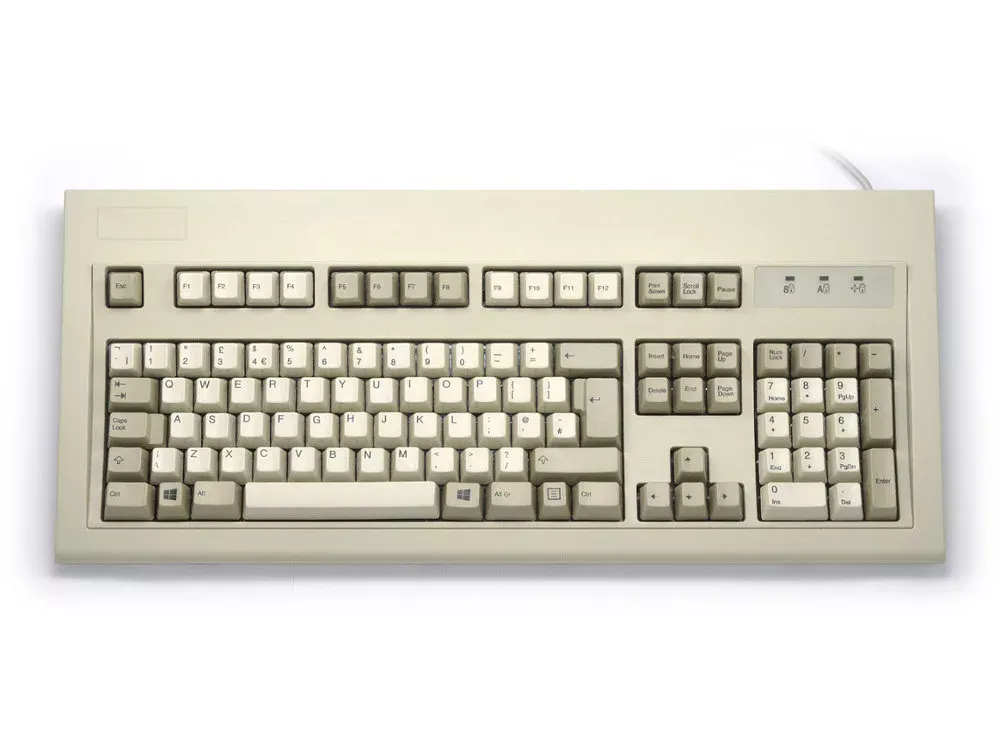
At the centre of this relationship sits the vintage IBM Model-M keyboard and its “Catastrophically Buckling Spring” mechanism. This device operates on a principle of “physical determinism”. Unlike the ambiguity of a membrane switch- where actuation is gradual and indistinct- the Buckling Spring offers a binary reality. The spring compresses, resists and then catastrophically buckles at a force of approximately 65cN. This tactile collapse- accompanied by the auditory report of the hammer striking the plate- signals to the central nervous system that an action has been taken with zero ambiguity.
I propose that this mechanical certainty has a startling psychological effect: it eradicates the micro-hesitations of doubt. In writing, doubt is the enemy of momentum. When the hardware assumes the burden of verification, the mind is liberated to focus entirely on the architecture of its argument.
However, the most pertinent insight is the paradox of resistance. One might assume that a heavy, mechanical “clicky” keyboard is designed for speed, yet its true value lies in how it slows the process down to a point of critical density. The physical effort required to actuate the switch creates a subconscious filter; the energy expenditure demands that the transmitted thought be worthy of the keystrokes.
This phenomenon creates a “Magnifying Glass Effect”. The resistance of the keys concentrates the scattered rays of the writer’s intellect into a single, burning focal point. The text produced is not necessarily more voluminous, but it is significantly more cogent. The writer does not “drift” into a sentence- they commit to it.
This ecosystem of seriousness is supported by the inclusion of a high-precision pointing device like the Microsoft Classic IntelliMouse. Just as the keyboard drives the creation of content, a well-engineered mouse acts as a surgical instrument of editorial revision within a word-processor. The mouse’s X-Y resolution is up to 3200 points per inch and the tracking speed is up to 40 inches per second. The ergonomic shape fits the right hand perfectly and when the mouse is moved on the desktop surface it tracks with laser-like precision to the hand’s intent- creating an environment where the editing process becomes as rigorous and focused as the writing process with the keyboard.
Ultimately, the lesson of these human interface input devices is one of embodied cognition. We reinforce cogency through tactile feedback from our fingers as we type our thoughts. When the interfaces are flimsy, our thoughts risk becoming superficial; but when the interfaces are substantial, determinant and precise, they act as a rigid challenge to the writer’s intellect. The contemporary Unicomp Model-M keyboard (featuring Buckling Spring technology) and Microsoft IntelliMouse demand conviction from their operator, and in doing so, they grant the writer the power to communicate with that same conviction.
Lee Wilkin